

Alternative Investments: The Complete 2025 Guide
High-Risk Investments: What They Are, Types, and How to Manage Risk
Every financial decision carries some level of risk, but in the vast universe of the markets, some investments involve significantly higher volatility and probability of capital loss than others. These are known as high-risk investments.
What Is a High-Risk Investment?
Definition and Key Characteristics
High-risk investments are defined by their high probability of suffering a significant loss of invested capital and their great uncertainty regarding future returns. They are characterized by strong volatility, meaning their prices can experience large daily or weekly fluctuations.
Unlike low or medium-risk investments, high-risk ones often operate in environments where information may be limited, liquidity is lower, and the regulatory framework is sometimes less strict or still emerging. This makes them more sensitive to economic, political, or sector-specific changes.
Risk-Return Relationship: More Potential, More Uncertainty
In investment theory, there is a fundamental principle: the higher the risk taken, the higher the potential expected return. However, it is crucial to understand that this potential is not a guarantee; it simply indicates that the asset has the possibility of generating extraordinary gains, but with an equivalent probability of generating large losses.
Types of Investments by Risk Level
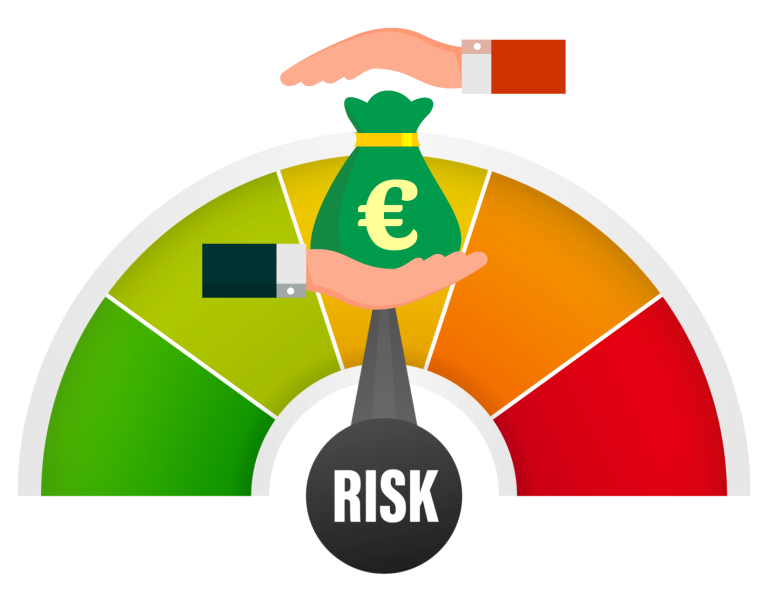
According to financial standards (such as those from IEBS), risk is categorized as follows:
- Low Risk: Seeks capital preservation with modest, predictable returns. Examples: savings accounts, fixed-term deposits, or high-grade government bonds.
- Medium Risk: Seeks a balance between safety and growth. Volatility is manageable. Examples: diversified index funds or “blue-chip” stocks.
- High Risk: Seeks maximum growth through extreme volatility and carries a risk of total loss. Examples: certain cryptocurrencies, leveraged products, or penny stocks.

Factors Influencing Risk Level
- Volatility: How much the asset’s price moves over a period.
- Liquidity: The ease and speed with which an asset can be sold without affecting its price.
- Regulation: Assets operating with less oversight (e.g., emerging crypto areas) are riskier.
- Issuer Solvency: The financial health of the entity issuing the asset (government or company).
Common High-Risk Investment Instruments
1. Volatile Stocks: Penny Stocks and Emerging Markets
- Penny Stocks: Shares of companies with low market capitalization. They often have low liquidity and high bankruptcy risk.
- Emerging Markets: Investing in developing economies offers great potential but involves political instability and currency fluctuations.

2. Currencies, Cryptocurrencies, and Leveraged Products
- Forex: Trading volatile currency pairs, often using leverage (borrowing to increase a position), which magnifies both gains and losses.
- Cryptocurrencies: Decentralized digital assets (Bitcoin, Ethereum, altcoins) characterized by extreme volatility and evolving regulation.
- Leveraged Products (CFDs, Futures): These allow investors to control large positions with little capital, which can result in losses exceeding the initial investment.
3. Venture Capital, Startups, and Crowdfunding
Investing in early-stage companies with high growth potential but a low probability of success. These are long-term, illiquid investments.
Advantages and Disadvantages
Pros:
- Possibility of extraordinary returns.
- Exposure to innovative sectors (Space tech, Biotech, Web3).
- Market agility for active investors.

Cons:
- Capital Loss: The high probability of losing a substantial part or all of the money.
- Emotional stress due to extreme volatility.
- Difficulty in making accurate market predictions.
Risk Management and Diversification Strategies
- Portfolio Diversification: Do not put all your eggs in one basket. Combine different asset types that do not move in tandem.
- Stop-Loss Orders: Automatic orders to sell an asset if its price falls to a predefined level, limiting losses.
- Periodic Reviews: Regularly evaluating the portfolio to ensure risk stays at the desired level.
High-Risk Investments and Cryptocurrencies: The Role of Bitsa
Cryptocurrencies are high-volatility assets. A common strategy for crypto investors is to separate “investment” from “daily spending.” Once you decide to take profits or use your crypto, you need a bridge to legal tender (Euros or Dollars).

How Bitsa helps?
Bitsa does not act as an investment advisor. Instead, it provides a practical solution to manage the results of your investment decisions.
- Bitsa provides a VISA card and an app that allows you to top up with cryptocurrencies (Bitcoin, Ethereum, etc.) and instantly use them as Euros.
- You can pay at physical and online stores or withdraw cash from ATMs.
Conclusion: Understand Risk Before Seeking Returns
The search for high returns inherently requires taking high risks. Before investing, it is essential to:
- Understand the instrument: Know how it works thoroughly.
- Assess the fit: Ensure the risk matches your financial situation.
- Know your margin: Only invest money you are willing to lose.

If you have already decided on your investment strategy and are looking for a simple way to use your money day-to-day, Bitsa allows you to manage your Euros and cryptocurrencies from a single app and card.