

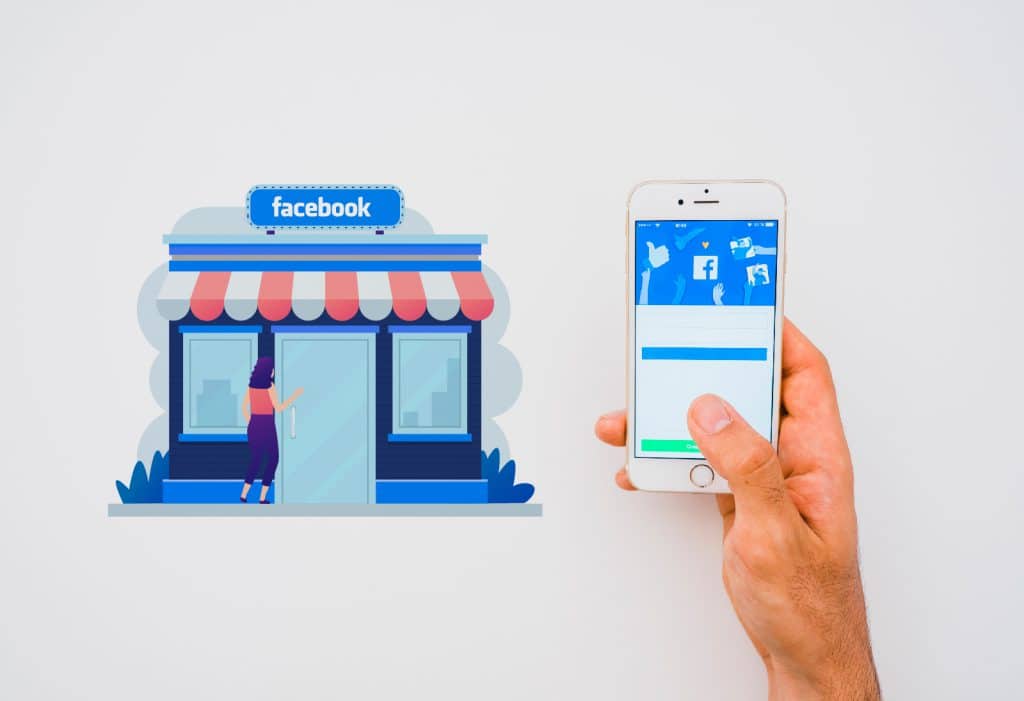
Facebook Shop, the gateway to ecommerce
When Facebook launched Shops in May 2020, the idea was to compete with Amazon or Shopify from inside the social network itself: integrated catalogue, tagged posts and payment using the details saved in the app. Five years later, that approach has changed completely. In August 2025, Meta finished removing native checkout globally, and Facebook Shop has remained as a storefront that redirects purchases to the seller’s website.
What is Facebook Shop?
Facebook Shop is the feature that allows a business with a Facebook Page to create a product catalogue and present it inside the social network itself. The company uploads photos, prices, descriptions and variants, organises products into collections, and the catalogue appears as a tab within the business Page.
Products can be tagged in posts, stories or Reels, so that anyone who sees them can tap the tag and go directly to the product page inside the shop.
In its current form, that product page no longer completes the purchase: when the user taps “Buy”, the app redirects them to the business website to process payment and shipping.
From the 2020 launch to the current model
The project has gone through three very different phases.
The first, between 2020 and 2022, was an expansion phase. Meta launched Shops in multiple countries, integrated commerce features into several of its apps and introduced Facebook Live Shopping, with live broadcasts where products could be purchased in real time. The strategy was aligned with the rise of social commerce during the pandemic.
The second phase came in 2022 and 2023, with major cutbacks. Meta shut down Facebook Live Shopping in October 2022 and applied its equivalent in March 2023, reduced investment in the project and, in countries such as Belgium, even disabled Shops completely when the native checkout requirement then in force was not met.
The third phase was consolidated in 2025. In June, Meta announced the gradual end of checkout inside its apps for all sellers worldwide, with the transition completed before the end of August. Since then, all purchases started inside Facebook Shop are completed on the seller’s website. European regulation, especially the Digital Services Act, has also reinforced transparency obligations around sellers and product traceability on platforms of this type.
How a purchase from the feed works
The typical flow today is the same in any market.
The user sees a tagged product in a post, story or Reel, taps the tag and lands on the product page inside the business’s shop on Facebook. From there, they can check variants, prices and descriptions. When they decide to buy, the app redirects them to the seller’s website, where the selection is completed, shipping details are entered and payment is made.
Payment, shipping, invoicing and after-sales support are managed entirely in the external store, with the payment methods and conditions configured by the seller. Facebook Shop acts as a source of qualified traffic: it identifies an interested buyer and takes them to the seller’s checkout.
There are exceptions with some integrated sellers, such as large brands or Meta partners, where part of the conversation can start from WhatsApp Business, with a direct chat to check availability, negotiate shipping or pay through links generated in the conversation.
How it differs from Facebook Marketplace
The two names are often confused, but they cover very different uses.
Facebook Shop is for businesses. It requires a business Page, a structured catalogue and compliance with the tax and traceability obligations of any ecommerce operation. In most cases, the products are new, and the seller is an identified company.
Facebook Marketplace is a platform for classified ads between individuals, similar to Wallapop. The sale takes place directly between the two people, without an integrated payment system or buyer protection equivalent to that of a store. Most use cases focus on second-hand items and local buying and selling.
This coexistence creates a hybrid market in which many young users discover products on social media even if they complete the purchase on the seller’s website. This analysis of what millennials buy and how they pay for it shows that behavioural shift with concrete data.
Precautions when buying on social media
Buying through ads or stores discovered on Facebook adds specific risks compared with traditional ecommerce. The constant appearance of unknown sellers, the ease of cloning a business Page and the mix of organic content with advertising make prior verification more important than in a store you reach through a direct search.
Before buying from a store discovered on social media, it is worth checking the age of the Page, reviews from other buyers, the existence of its own website with legal information (legal notice, returns policy, physical contact details) and opinions outside the social network itself. These and other signals are covered in the guide to buying online safely.
The payment method also changes the level of exposure. Using a prepaid card with a controlled balance, such as Bitsa, reduces the risk: even if the details ended up in the wrong hands, the maximum loss would be the balance loaded at that moment. And because every online purchase goes through 3D Secure with confirmation in the app, fraudulent use would also require access to the phone.
Facebook Shop is still alive, but it is no longer the full sales platform Meta presented in 2020. It is a storefront that sends the purchase to the seller’s website and works as a gateway to traditional ecommerce. For users, what has changed is not the ability to discover products on social media, but the importance of choosing carefully where to click and which card to use for payment.
Frequently asked questions
Does Facebook Shop still exist?
Yes, but with reduced functionality. Meta removed native in-app checkout globally in August 2025, shut down Facebook Live Shopping in 2022 and redirected the project towards commerce with creators, Reels and WhatsApp Business. The catalogue and product tagging features remain active.
Can you pay directly inside Facebook?
No. Since August 2025, all purchases started in Facebook Shop are completed on the seller’s website. Payment, shipping and after-sales support are managed entirely by the external store.
What is the difference between Facebook Shop and Facebook Marketplace?
Facebook Shop is for registered businesses that usually sell new products, with a structured catalogue and tax obligations. Facebook Marketplace is a classified ads platform between individuals, without an integrated payment system, and is more focused on second-hand items and local buying and selling.
Is it safe to buy on Facebook Shop?
It depends on the seller. The platform does not guarantee the reliability of the company behind each shop, so the same precautions that apply to traditional ecommerce are valid: check the age of the Page, look for opinions outside the social network and use payment methods that limit data exposure.
How much does it cost businesses to open a Facebook Shop?
Creating the shop is free. Since checkout has moved to the seller’s website, the associated costs are those of the ecommerce platform used by the business (Shopify, WooCommerce, PrestaShop or others), plus advertising costs if the business runs campaigns to drive traffic to the store.
How can I protect my data when buying on social media?
Verifying the store before buying, avoiding entering your main card details, using a prepaid card with a controlled balance and checking that the payment is processed with 3D Secure (with mobile confirmation) reduce exposure to fraud and limit the loss in case of an incident.