

Free virtual card without a bank account: how to get one
You are not the first person who wants to pay online but does not have a bank account, or simply prefers not to link one. Maybe you just want to keep your financial data private. The good news is that there is a solution: prepaid virtual cards. They are fast, flexible, and increasingly popular in Europe.
You do not need to rely on a bank or wait days. In just a few minutes, you can have a card ready to use. In this article, we explain what they are, how they work, what options you have, and how to get one step by step.
What is a prepaid virtual card and how does it work
A prepaid virtual card is not very different from what you already know. It is a digital card with all the details needed to pay online: a 16-digit number, expiration date, and CVV code.
However, there are some differences compared to a traditional physical card. These cards do not have a physical format. They also do not include a magnetic stripe since they exist only on your mobile device. For this reason, their use is mainly limited to online payments, although if you add them to Google Pay or Apple Pay, you can also pay in physical stores.
Virtual cards are issued by authorized electronic money institutions, not banks. This is the key difference: they are not linked to a current account or a credit line. You can only spend the balance you have previously loaded.
This offers a clear advantage: if someone gains access to your card details, the risk is limited to the available balance, not your entire savings. That is why they are ideal for online payments where you cannot see what is on the other side of the screen.
Wallet account vs. prepaid card: what is the difference
When you start researching prepaid virtual cards, two terms often appear and can be confusing: wallet account and prepaid card.
Although they are related and often come together, they are not the same. Understanding the difference is key to knowing how these services work and what happens to your money.
To make it clear:
Wallet account: a digital space where your balance is stored as electronic money.
Prepaid card: the tool that allows you to spend that balance.
Many services integrate both. This means you create a wallet account and a virtual card is automatically generated. It is also important to note that your balance does not disappear if the card expires or is deleted. On most platforms, your money remains in the wallet account and can be recovered or transferred.
You should also understand that “free prepaid card” does not always mean “no fees.” The card may be issued for free, but there can still be charges for inactivity, top-ups, or withdrawals depending on the platform. For example, Bitsa does not charge inactivity fees, but other providers might.
What options are available in Europe
In Europe, there are several alternatives to get a prepaid virtual card. Online services continue to grow, giving users more choices. If you are looking for a practical option, focus on three criteria:
-
Free card issuance
-
No requirement for a bank account
-
Compatibility with Visa or Mastercard
Here are some of the available options:
- Revolut: offers multi-use and disposable virtual cards that change details after each purchase, ideal for secure transactions.
- N26: allows you to create a free virtual card via its app. You can have up to six virtual cards with premium plans.
- BBVA Aqua Virtual: a virtual prepaid card from a traditional bank with no issuance or maintenance fees.
- CaixaBank CyberTarjeta: a prepaid virtual card not linked to a bank account, instantly issued via CaixaBankNow. It has a 1.5% top-up fee (minimum €1.5).
- Trade Republic: a virtual card with investment features and cashback through its Saveback system.
Why choose Bitsa
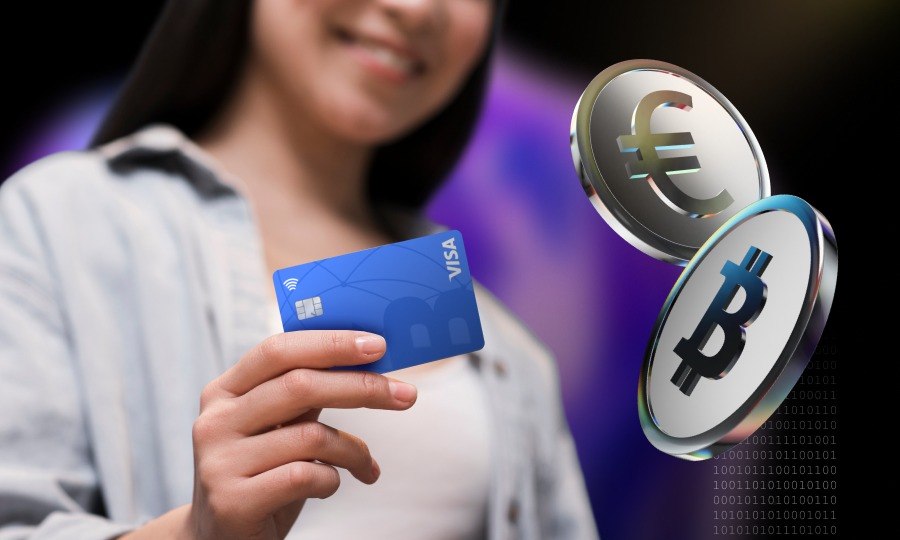
Bitsa stands out from the options above for several reasons:
-
You can issue a free virtual card instantly from the app
-
No bank account required
-
You can top up with cryptocurrencies, bank transfer, or card. You can also top up with cash using vouchers available at hundreds of locations
-
Option to request a physical card as well
What mainly differentiates these cards is the available top-up methods, the payment network (Visa or Mastercard), and the fully digital experience. Bitsa stands out by allowing crypto top-ups, something not all providers in Europe offer. If you are into crypto, this is definitely a strong option.
How to get one step by step
If you have decided to get one, the process is simple and fast. In most cases, it takes less than ten minutes. Here are the basic steps:
-
Download the app or access the provider’s website (in our case, Bitsa App)
-
Register with your personal details (name, email, phone number, and sometimes address)
-
Verify your identity (KYC). The KYC process is mandatory and usually involves uploading an ID and sometimes a selfie or video verification
-
Wait for confirmation. Once verified, your virtual card is issued instantly or within minutes. In Bitsa, you will see it on the app’s main screen
-
Make your first top-up using transfer, bank card, Bizum, or cryptocurrencies depending on the provider
These processes are designed to be smooth and fully digital, so you do not depend on office hours or paperwork.
What can you use it for
A prepaid virtual card is useful in many everyday situations:
-
Online shopping in Europe and abroad
-
Subscriptions (streaming, software, digital tools)
-
Payments on platforms where you prefer not to use your main card
-
One-time services where you want to limit data exposure
-
In-app purchases and gaming
Overall, it is a practical way to separate your online spending from your main finances.

How to control your spending
One of the biggest advantages of prepaid cards is control. You can only spend what you load, which allows you to:
-
Load specific amounts before each purchase
-
Set spending limits via the app
-
Track transactions and balance in real time
This also helps avoid unexpected charges or unauthorized payments. It is especially useful for subscriptions: if there is no balance, the payment will not go through.
Bitsa is a strong option for managing everything from your phone and keeping a clear view of your spending without relying on a traditional bank account. In general, virtual cards are highly useful, especially in an increasingly digital world.

FAQ
Can I get a virtual card without a bank account?
Yes. Prepaid virtual cards do not require linking a bank account. They work with preloaded funds.
Where can I use a prepaid virtual card?
Mainly for online purchases and digital services. If added to Google Pay or Apple Pay, you can also use it in physical stores.
Are virtual cards safe?
Yes. Since they are not linked to your bank account and only use available balance, risk is limited in case of fraud.
What is the difference between a prepaid card and a wallet account?
A wallet account stores your money, while the prepaid card is used to spend it.
Can I top up a virtual card without a bank?
Yes. Some platforms allow top-ups via crypto, cash, vouchers, or other cards.
What happens if the card expires or is deleted?
Your money is not lost. It usually remains in your wallet account and can be reused or transferred.