

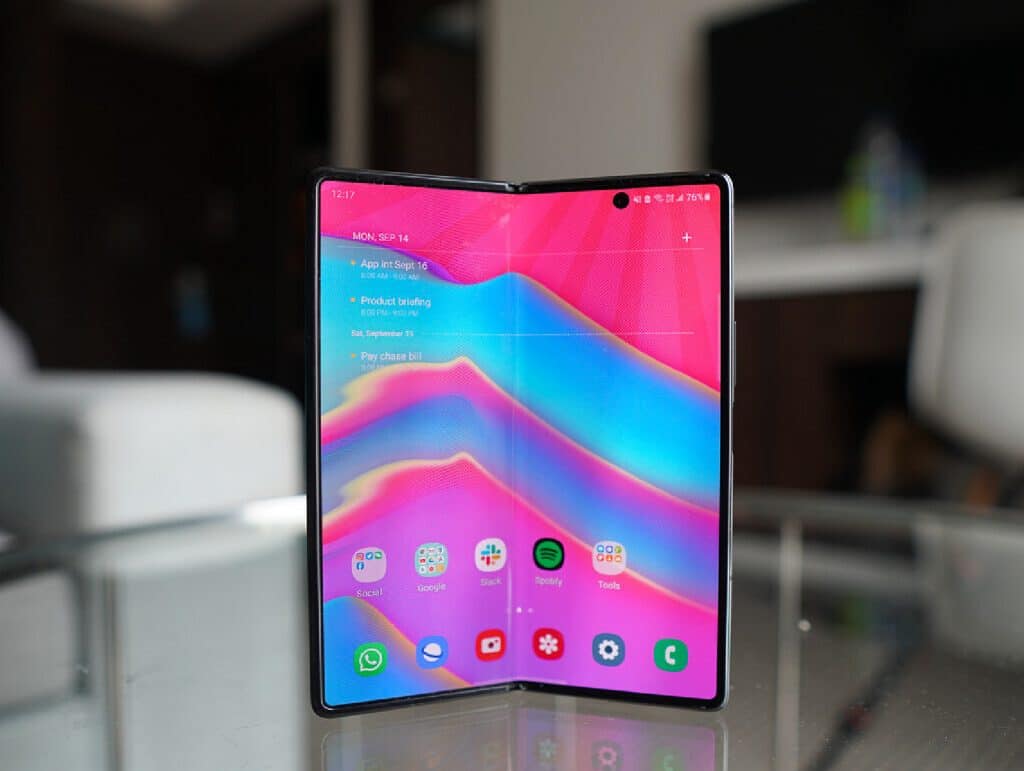
How the Galaxy Z Fold has evolved
When Samsung introduced its first Galaxy Fold in 2019, foldable phones were a technological curiosity with more promise than real usefulness. Six years later, the seventh generation is the thinnest and lightest foldable in the brand’s catalogue, with a 200-megapixel main camera and a price close to €2,000. The category has consolidated, Asian competition has entered strongly and Samsung continues to lead in Europe. These are the changes the Fold line has gone through and where the model stands today.
From the original Fold to the Fold 7
The first Galaxy Fold arrived in 2019 with a book-style format, a vertical hinge and a 7.3-inch inner display. It was expensive, bulky and had durability issues that even Samsung acknowledged, forcing the company to delay the commercial launch after identifying faults in the test units sent to the press.
The Fold 2 (2020) was the first step towards maturity: a larger cover screen, a better hinge and a clear improvement in user experience. From the Fold 3 to the Fold 6 (2021-2024), Samsung refined the model with S Pen support, IPX8 water resistance, a more useful cover screen and increasingly powerful processors, but it still kept a weight and thickness that limited the appeal of the format.
The Galaxy Z Fold 7, launched in July 2025, is the most radical leap since the Fold 2. At 4.2 mm thick when open and 8.9 mm when closed, it is the thinnest foldable in Samsung’s catalogue and one of the slimmest on the global market. It weighs 215 grams, 24 less than the Fold 6, and competes directly with the Honor Magic V5 and the Oppo Find N5 in the three metrics that matter most to users: thickness, weight and camera quality.
What the Galaxy Z Fold 7 offers today
The specifications of the Galaxy Z Fold 7 place it at the very top of Samsung’s range.
The main display is an 8-inch Dynamic AMOLED 2X panel with a 120 Hz refresh rate. The outer screen measures 6.5 inches and uses the same technology. Both include Corning Gorilla Glass Ceramic on the front, with greater scratch resistance than previous generations.
In the camera section, the most talked-about new feature is the 200-megapixel main camera, a significant jump from the 50 MP sensor on the Fold 6. It is accompanied by an ultra-wide sensor, a telephoto lens and a front camera with configurations designed for video and selfies while using the folded device.
For performance, it uses the Snapdragon 8 Elite for Galaxy, with 12 or 16 GB of RAM and storage options of 512 GB or 1 TB. The battery keeps the same 4,400 mAh capacity as the previous model and supports fast wired and wireless charging.
On the software side, it runs One UI 8 on Android 16 with integrated Galaxy AI features: automatic text summaries, simultaneous translation, image generation and a deep conversational assistant layer.
The Fold 7 price compared with the rest of the high-end range
The official launch price in Spain starts at €1,999 for the configuration with 12 GB of RAM and 512 GB of storage. The 16 GB version with 1 TB reaches €2,239.
This price remains in line with the high-end foldable segment. The iPhone Pro Max, Samsung Galaxy S25 Ultra and Google Pixel 10 Pro XL are the direct comparisons in non-foldable format, with prices above €1,400 in their highest configurations. Against Asian foldables, the Honor Magic V5 and Oppo Find N5 sit in a similar range, between €1,700 and €2,100 in Europe, although with more limited availability in the Spanish market.
The recommended price remains high both during pre-order and throughout the first year of the product cycle. The real price drop usually arrives as the next generation approaches, when electronics retailers and refurbished platforms apply significant discounts.
The foldable phone market in 2026
Foldables have gone from technological oddity to consolidated category, but they still represent a minority of the overall mobile market. According to aggregated manufacturer data, global foldable sales are around 20 million units a year, approximately 1.5% of the total smartphone market.
Samsung maintains leadership with close to 45% of the segment share, followed by Huawei (outside the EU), Honor and Oppo. In Europe, the presence of Chinese manufacturers is lower due to regulatory barriers and the lack of official stores, which consolidates Samsung as the default reference.
The main change over the past two years has been technical focus. The reduction in thickness and weight, improved camera quality and dust resistance (Samsung introduced IP48 on the Fold 7) have corrected the three weak points that the format had carried since the original launch.
How to buy a premium phone without draining your finances
A €2,000 phone is not a minor purchase. Before clicking “buy”, it is worth planning how to pay for it so that the investment does not throw the rest of the month’s finances off balance.
The first option is to plan the expense in advance. Setting the amount aside in a separate account or card over several months reduces the impact of a single charge of that size. Using an online prepaid card to save in the short term is a simple way to separate savings from everyday spending, set a deadline and reach launch day with the money already put aside.
The second is to use deferred payments (Buy Now, Pay Later) integrated into the checkout of Samsung, Amazon or MediaMarkt. This model allows the payment to be split into interest-free instalments in its standard version and usually works well for high-value electronics purchases.
The third, especially relevant for those who hold savings in crypto, is to pay directly from a prepaid card topped up with cryptocurrencies. Bitsa allows you to convert crypto balance into euros and load it onto the card to shop on Amazon, Zalando or MediaMarkt without intermediaries or gift cards.
And for everyday use of the phone, activating contactless payments from a prepaid card integrated with Apple Pay or Google Pay is what really makes use of the hardware’s capabilities. A foldable such as the Fold 7 loses part of its value if you still pay in cash or insert a physical card into every payment terminal.
The Galaxy Z Fold 7 marks the point at which Samsung’s foldables have stopped being held back by their own technical limitations. It is a thin, light phone, with a camera at flagship level and a price still reserved for a specific type of buyer. The category has matured, but the purchase decision still depends both on whether the format fits your daily use and on how you integrate it into your budget.
Frequently asked questions
How much does the Galaxy Z Fold 7 cost in Spain?
The official launch price in Spain starts at €1,999 for the configuration with 12 GB of RAM and 512 GB of storage. The 16 GB version with 1 TB reaches €2,239.
Is it worth upgrading from the Fold 6 to the Fold 7?
It depends on how you use it. The Fold 7 introduces significant improvements in thickness, weight and the main camera (200 MP), but keeps the same battery capacity as the Fold 6. For anyone coming from a model earlier than the Fold 6, the upgrade is clearer.
What are the main competitors of the Galaxy Z Fold 7?
In the book-style foldable segment, its direct rivals are the Honor Magic V5 and the Oppo Find N5. In the broader high-end segment, it competes with the iPhone Pro Max, the Samsung Galaxy S25 Ultra and the Google Pixel 10 Pro XL.
Is it water and dust resistant?
The Galaxy Z Fold 7 has an IP48 rating: freshwater resistance up to 1.5 metres for 30 minutes and partial dust resistance. It is the first time Samsung has added dust protection to the Fold series.
How can I pay for a €2,000 phone without throwing my finances off balance?
The most common options are planning your savings in advance by setting the amount aside in a separate card or account, using interest-free deferred payments offered by major electronics retailers, or paying with a prepaid card loaded with cryptocurrencies converted into euros. Combining the three can reduce the impact of a single charge.