

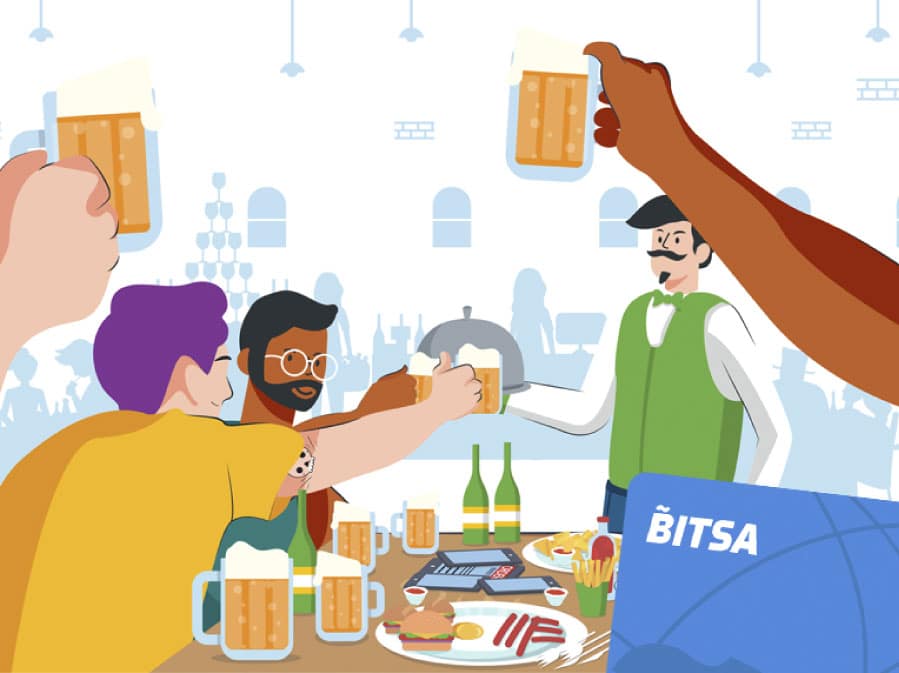
Russian cards: the game to decide who pays the bill
Finishing a meal with friends and reaching the moment of the bill can be the most awkward part of the evening. There are those who pull out the calculator and work out to the last cent what everyone ordered, those who split equally without discussion, and those who gamble by placing all cards face down and letting the waiter pick which one pays the whole bill. This last one is the game known as Russian cards.
This article covers how the game works, when it makes sense and when it doesn’t, other common ways to split the bill, and how to handle the digital payment part quickly between friends who don’t share the same app or bank.
What Russian cards are
Russian cards is a social game to randomly decide who pays the full bill of a meal shared by several people. The name plays on the parallel with Russian roulette (one participant “gets hit”) but with far lighter consequences: paying dinner for everyone.
It’s a tradition widespread in Spain and several Latin American countries, especially in groups of friends who go out with some frequency and where the total evens out on average over time. By the end of the year, whoever “gets hit” several times usually matches with someone who was hit only once.
How to play step by step
The process is simple.
- Collect the payment cards of all diners who want to play. Credit, debit, or prepaid all work.
- Place them all face down on the table, mixed.
- Ask the waiter (or someone outside the group) to pick one at random.
- The person whose card is picked pays the full bill.
There’s a more fun elimination variant with more suspense. Instead of picking the “loser” directly, cards are eliminated one by one: the waiter lifts one, it goes back to its owner (who’s safe), lifts another, returns it, and so on until only one remains on the table. That person pays. It stretches the moment and adds tension.
Other common ways to split the bill
Russian cards is one option among many. These are the most common in groups of friends.
Equal shares. The total divided by the number of diners. Fast and no calculations, but can be unfair if someone ate or drank significantly less than the rest.
Each pays their own. The bill is separated by diner. Requires the restaurant to allow it (not all do) or someone to do the maths. Fairest option, but slower.
Rotating turns. One person pays the full bill each time the group goes out. Works well in groups that meet often and with similar economic capacity. Requires collective memory on whose turn it is.
The birthday person doesn’t pay. Widespread tradition especially in younger groups. Everyone else splits the birthday person’s share among themselves.
One payer who then collects. One person fronts the bill at the restaurant and everyone pays their share back by digital transfer. It’s the fastest for the restaurant and the most common in groups used to instant payment apps or Bitsa-to-Bitsa transfers.
Digital payments between friends today
Regardless of the chosen method, the “and now I’ll send it to you” part has become much easier in recent years. Different European countries have their own dominant instant-payment services: Bizum in Spain, Lydia in France, Satispay in Italy, Wero across Europe. But there are still situations these don’t cover well: friends with accounts in non-participating banks, people without traditional bank accounts, or groups with mixed nationalities where not everyone uses the same service.
In those cases, other routes work better.
Direct transfers between Bitsa users. If the group has several Bitsa users, instant transfers can be made between them using a phone number or a unique code generated within the app. The amount arrives on the recipient’s balance in seconds, without internal fees.
International “split bills” apps. Splitwise is the best known for tracking accounts between friend groups over time, especially useful in shared flats, trips, or recurring dinners with the same group.
SEPA Instant transfer. If the amount is high or there’s no faster option, SEPA Instant transfers between European accounts arrive in seconds and are reliable.
A Bitsa card fits well especially in international groups or when some friends don’t have an active local bank account. As a prepaid Visa card with an associated IBAN, it works to receive SEPA transfers from anyone, and transfers between Bitsa users are instant and fee-free.
When to avoid the Russian cards game
Russian cards works as social fun only when there’s balance between participants. There are situations where it’s better not to play.
Large economic differences in the group. If one diner earns significantly less than the rest, “getting hit” with the bill can be a real blow to their monthly budget. Even if the game is framed as a joke, the consequences aren’t.
Very high bill. Dinners with prices that exceed what anyone in the group would pay alone. In high-end restaurants or celebration dinners, choose another method.
New person in the group. Someone invited for the first time may feel obligated to accept the game out of social pressure. It’s courteous not to force it.
Groups where the game isn’t cultural. Outside contexts where the game is known, some diners may feel uncomfortable with the mechanics. If in doubt, ask before proposing.
General principle: the game is agreed on before ordering, not when the bill arrives. No one should learn they’ve played Russian cards after having spent more than expected.
Frequently asked questions about Russian cards and paying between friends
Why is it called “Russian cards”?
The name plays on the comparison with Russian roulette: one participant is picked at random and takes the consequence. In this case the consequence is paying the full bill, much lighter than in the original game.
Can you play with prepaid cards?
Yes. Any payment card accepted by the restaurant works. Just check before playing that prepaid cards have enough balance. If someone “gets hit” and the card doesn’t cover the amount, they’ll need to pay with another or top up on the spot, which breaks the game’s flow.
Is the game legal?
Yes, there’s no specific legal consideration. It’s a social convention between consenting adults. It doesn’t fall into the category of regulated gambling because there’s no cash prize and no commercial operator organising the game.
What if the “chosen” person doesn’t have enough balance or credit?
Depends on the group’s prior agreement. The usual practice is for the rest to “save” them by covering the amount between everyone and settling with the person who couldn’t pay later. Don’t leave the restaurant in the middle of a group’s financial situation.
Are there more balanced alternatives to Russian cards?
Rotating turns (one person pays each time) and splitting equally are the alternatives that usually generate less tension. For groups that meet rarely or with new members, splitting by what was consumed is fairest.