


Diderot Effect: the phenomenon that empties your wallet
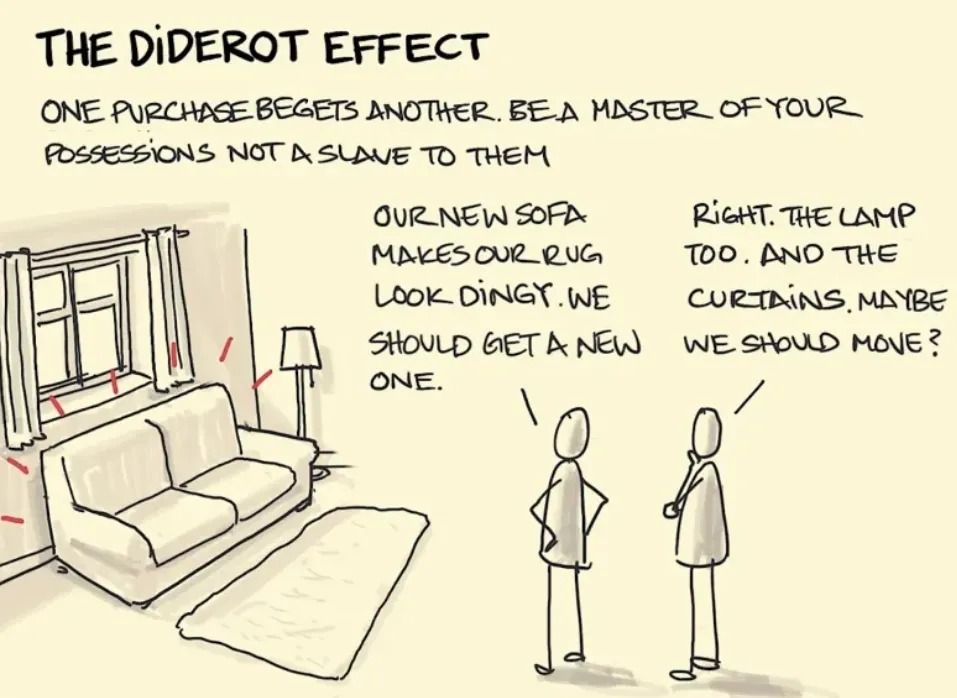
You get new sneakers and suddenly your workout clothes look worn out. You buy an iPhone and your tech setup starts to bother you. What seems like an innocent impulse is actually a psychological trap: the Diderot Effect.
This phenomenon explains why a single acquisition breaks the harmony of what you already have, pushing you into a spiral of spending to «live up to» the new item. It is the art of buying things you didn’t need to match something you just purchased.
How to prevent this effect from dominating your finances? In this article we analyse:
- The origin:The curious story of the luxury robe that ruined a philosopher.
- The trigger: Why your brain hates it when your objects don’t «match».
- The solution: Key strategies to regain control and stop the spiral before your wallet says enough.
What is the Diderot Effect, and where does it come from?
It all started in 1772, when the philosopher Denis Diderot received a gift: a luxurious red silk robe. It was so perfect that suddenly his old desk looked mediocre. His straw chair felt like an insult. His bookcase, a shame.
To «live up to» his robe, Diderot started changing everything. In a short time, he renewed every piece of furniture in his house and ended up deep in debt. What began with a single garment ended in financial ruin.

Two centuries later, anthropologist Grant McCracken gave this drive a name: Diderot Effect. It is the phenomenon that occurs when a single purchase breaks the harmony of what you already have:
- The trigger: You buy something of high quality.
- The dissonance: Your old possessions seem «not to fit» with the new one.
- The spiral: You start buying complementary accessories, clothes or furniture to regain «coherence».
The danger is not the object, it is the pattern. Modern businesses know this and use it so that, after buying the phone, you feel you need the headphones, the watch and the original case.
Why does the brain fall into this trap?
Is your brain sabotaging you? It is not that you lack willpower; it is that your brain is designed to seek harmony, and marketing knows it. Here is a direct comparison between what you think happens and what your brain actually does:
|
Mechanism |
What the brain feels |
The result (The trap) |
| Seeking coherence | «This new object is great, but it makes everything else look old and ugly.» | You feel a false need to upgrade your entire environment so that it «matches». |
| Identity update | «Now that I have this, I am a more successful/fit/professional person.» | You discard the old because it no longer fits with your «new self». |
| Cognitive dissonance | «There is visual and status disorder in my room. I must fix it.» | You buy accessories to eliminate the tension of having things that don’t match. |
| Drag effect (Marketing) | «If I already bought the expensive coffee, I need the elegant cup and the designer spoon.» | You fall into cross‑selling: the first object is just the «hook» for the full ecosystem. |

Truthfully, your brain is not irrational, it is just obsessive about order. It would rather empty your bank account than allow your environment to be in «dissonance».
Situations where it appears without you noticing
You must be clear that the Diderot Effect is a master of disguise: it starts with a small, exciting purchase, but ends up dictating how your entire environment should look. It is not about a real need, but a «short circuit» in your brain that forces you to buy coherence so that the old does not clash with the new.
|
Category |
The Trigger |
The Trap |
| Technology and gadgets | A new smartphone with a better camera. | You need a premium case, then a tripod for that camera, a fast charger and matching headphones. The phone was just the start of the «ecosystem». |
| Home and decoration | A designer lamp or a new sofa. | The rest of the furniture looks «dull». You change cushions, then the rug, the coffee table, and you end up painting the living room to make the style «fit». |
| Clothing and sports | A pair of state‑of‑the‑art running shoes. | You feel your old cotton t‑shirt is not «up to par». You buy technical clothing, a GPS watch, supplements and even a blender for your post‑workout shakes. |
| Digital world | A new professional profile picture on LinkedIn. | Your previous feed seems sloppy. You delete old posts, change the aesthetics of your designs and update your bio. Your digital standard becomes more demanding. |
| Fashion and style | A pair of trendy trousers. | You realise your shirts are from past collections. You look for a jumper that matches, then the ideal coat and finally the shoes that complete the outfit. |
| Lifestyle inflation | A salary raise or promotion. | What was once «enough» now seems inadequate. You raise your standards in food, transport and leisure, creating new expenses that didn’t exist before. |

The danger is not the object itself, but the consumption spiral it unleashes by trying to make your external reality match your new expectation.
How to stop the Diderot Effect before it starts
Stopping the Diderot Effect is not about giving up the pleasure of new things, but about regaining control over your judgment. The goal is to prevent an isolated purchase from making decisions for you, transforming a natural impulse into a conscious and shielded consumption strategy.
|
Method |
How to apply it |
The real benefit |
| The 48‑Hour Rule | If you feel the urge to buy the «complement», wait two days. | The next morning’s coffee usually evaporates the urges that seemed urgent in the store. |
| Closed budget | Assign a maximum amount for a category before the first purchase. | You prevent the «need for harmony» from extending to money that was not intended for that purpose. |
| Utility vs. status filter | Ask yourself: «Am I buying this because it serves me, or because the old stuff makes me feel inferior?» | You break the association between your possessions and your personal worth. |
| Using Bitsa | Load only the leisure or consumption amount for the month onto your Bitsa card. | When the balance is gone, it’s gone. You create a physical limit that the spiral cannot jump. |
| Gratitude anchors | Identify an old object you love and refuse to change it (like Diderot’s rug). | It reminds you of your original state and stops consumer pride before it grows. |

Remember: Poverty has its freedoms, opulence its obstacles. Do not let a new object become the owner of your next crypto card.