

Spending cryptocurrencies without selling them on an exchange every time
For most cryptocurrency users, the daily purchase process usually follows a slow and predictable script: enter the exchange, sell the assets, wait for the bank transfer, and finally pay. A routine that is not only annoying but often generates discomfort. Whether because the market is down, due to tax friction, or simply because letting go of funds feels like giving up a long-term strategy, the traditional conversion often leaves a bitter taste.
The good news is that the ecosystem has evolved enough to break this cycle. Today, more and more people are looking to use their assets in daily life without giving up the pillars of the digital universe: privacy, speed, and control. And the reality is that there are many more alternatives to spend directly, without dealing with intermediaries or forced conversions, than most people imagine.
However, making the leap to direct consumption implies much more than scanning a QR code. To avoid losing value along the way, it is essential to carefully monitor fees, understand exchange rates, and select the right tools.

The problem of always going through an exchange
The traditional asset liquidation process — selling on an exchange, waiting for the transfer, and paying — introduces a series of obstacles that turn a simple action into an inefficient process. Although it is often seen as the only path, converting to fiat currency hides operational and financial costs that are often overlooked in everyday purchases.
When using an exchange for daily consumption, several problems immediately arise:
- Hidden costs and fees:The process involves paying fees for asset exchange and withdrawal fees to the bank.
- Temporal friction: Unlike crypto immediacy, the traditional banking system imposes its own timelines. Transfers can take hours or days, nullifying payment agility.
- The fiscal labyrinth: In most jurisdictions, swapping cryptocurrencies for fiat is a taxable event.
- Loss of privacy (KYC): Going through an exchange forces you to go through constant identity verification filters. The movement is recorded and linked directly to the bank account, eliminating the native privacy of the digital environment.
- Volatility: Forcing a sale when the market is down consolidates a financial loss and ruins any long-term investment strategy.
Therefore, the current solution is not to go back to the bank, but to adopt tools and merchants that allow using crypto balance directly at points of sale or accessing its value without needing to liquidate the assets. There are several options for using your cryptocurrencies to cover daily expenses.
Option 1 — Prepaid card topped up with crypto
Prepaid cards backed by digital assets represent one of the most agile bridges between the Web3 environment and traditional commerce. These instruments operate under global networks with mass acceptance such as Visa or Mastercard, with the particularity that their balance is managed directly through deposits in cryptocurrencies or stablecoins.
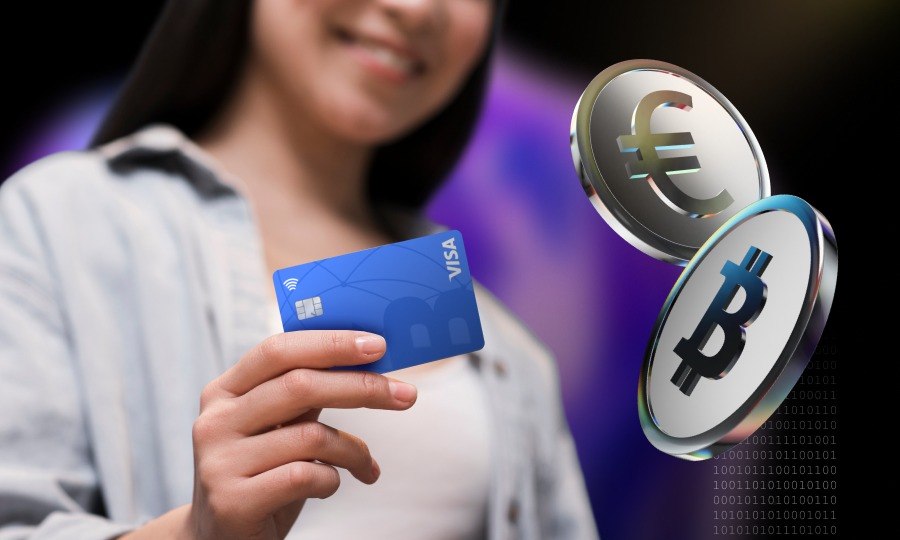
When using specialized tools like Bitsa card, the conversion to fiat currency is executed at the precise moment of the top-up. This allows the user to have a balance ready to spend at any physical or digital point of sale, eliminating the waiting times of usual bank transfers.
The process stands out for its operational simplicity and is summarized in three key phases:
- Balance management:The user transfers crypto funds from their private wallet directly to the card’s application.
- Immediate conversion: The platform automatically transforms the digital assets into the local currency, reflecting an available fiat balance in a cash account.
- Global spending: With the balance already converted, the card works like any conventional plastic for purchases in physical stores, e-commerce, ATM withdrawals, or through integration into mobile wallets.
All of this makes them a strategic alternative for global profiles such as freelancers, digital nomads, or simply users looking for isolated and direct management of their digital resources, protecting their main account and streamlining day-to-day purchasing power in a direct and efficient manner.
Option 2 — Pay directly with crypto where it is accepted
The purest way to use digital assets is to transfer funds directly from a private wallet to the merchant without going through any exchange. Today, this is a constantly expanding reality that allows you to purchase products in supermarkets, gas stations, gaming platforms, and travel agencies. The general process stands out for its simplicity: at the time of payment, the user simply selects the digital assets option, chooses their preferred cryptocurrency, and confirms the transaction by scanning a QR code from their mobile application.
The great catalyst for this modality is the Lightning Network, a second-layer solution specifically designed to enable everyday payments with Bitcoin. By processing transactions instantly and reducing network fees to fractions of a cent, this technology makes micropayments economically viable and fast, matching the speed of a traditional credit card but maintaining full control of the funds.
Despite these notable advantages, this type of payment still faces a significant limitation: its global coverage remains limited. Because direct acceptance depends on each merchant deciding to integrate crypto gateways into their terminals or websites, this alternative has not yet become a universal standard, forcing users to verify in advance which establishments accept this modality.
Option 3 — Gift cards purchased with crypto
Gift cards represent one of the most accessible ways to transform digital assets into everyday purchasing power. Through specialized platforms like Bitrefill, the user acquires a digital voucher using their funds directly from a private wallet, and then spends the balance in the physical or online store of the chosen brand like a traditional customer.

This alternative stands out for its flexibility and broad support, as it allows operations with Bitcoin, Ethereum, Solana, and stablecoins like USDC or USDT, facilitating consumption even in countries where native crypto payments are not yet widespread.
However, its main limitation is that usage is strictly restricted to the catalog of brands available on the issuing platform. Although the offer covers large e-commerce, entertainment, and transportation firms, the user must adapt their spending to existing commercial agreements.
What you need to start spending crypto without an exchange
To break dependence on exchanges and start using digital assets in daily life, you only need to set up a basic ecosystem focused on custody and operational agility:
- Your own wallet:It can be a hot wallet for quick, everyday expenses, or a cold wallet to maximize security.
- Available funds and network verification: Have a balance in the cryptocurrencies you plan to use and ensure that the destination merchant or gateway accepts the corresponding network before confirming any transaction via QR code or public address.
- A specialized prepaid card: For those merchants that do not yet accept native blockchain payments, having a prepaid card that supports top-ups with digital assets is the definitive tool to maintain liquidity without needing to touch a bank account.

Ready to take the step? Optimize your finances and regain control of your privacy. Download the Bitsa App, top up your card directly with your cryptocurrencies and start spending immediately at any merchant in the world, without waiting, without friction, and without going through an exchange.