

What is a sales funnel: stages, examples and how to build one
Almost everything you buy online has passed through a sales funnel first. The Instagram ad you scrolled past, the free guide you downloaded in exchange for your email, the 10% discount that landed in your inbox two days later and the “only 3 left in stock” warning are all part of one journey designed to take you from “never heard of this brand” to “just paid”.
This guide explains what a sales funnel is, what stages it has, how to build one step by step if you run a business, which metrics to track and which privacy rules apply in Europe. And since you are also a shopper, we finish with the other side: how to spot a funnel when you are inside one, so it does not decide your budget for you.
What is a sales funnel?
A sales funnel is a model that describes the path a person follows from discovering a product to buying it and, ideally, buying again. It is drawn as a funnel because people drop out at every stage: many see an ad, fewer visit the website, fewer still add something to the basket and only some of them end up paying.
The idea is not new. Salespeople have used similar models for more than a century, such as the well-known AIDA framework (Attention, Interest, Desire, Action). What has changed is that online, every step can be measured: you know how many people came in, where they left and which message worked best. That turns the funnel into a practical tool rather than a nice diagram for a slide deck.
It is worth not confusing it with a sales pipeline. The funnel looks at the process from the customer’s point of view (what they think and need at each moment). The pipeline looks at it from the sales team’s side (what stage each deal is at, what it is worth and who owns it). They complement each other: the funnel tells you why customers drop out, the pipeline tells you how much you will sell.
The stages of a sales funnel
There are many versions of the funnel, but almost all of them fit into three broad zones known by their acronyms:
- TOFU (Top of the Funnel): the person realises they have a problem or need and starts looking for information.
- MOFU (Middle of the Funnel): they know what they want and are comparing options.
- BOFU (Bottom of the Funnel): they are ready to decide and just need a final nudge.
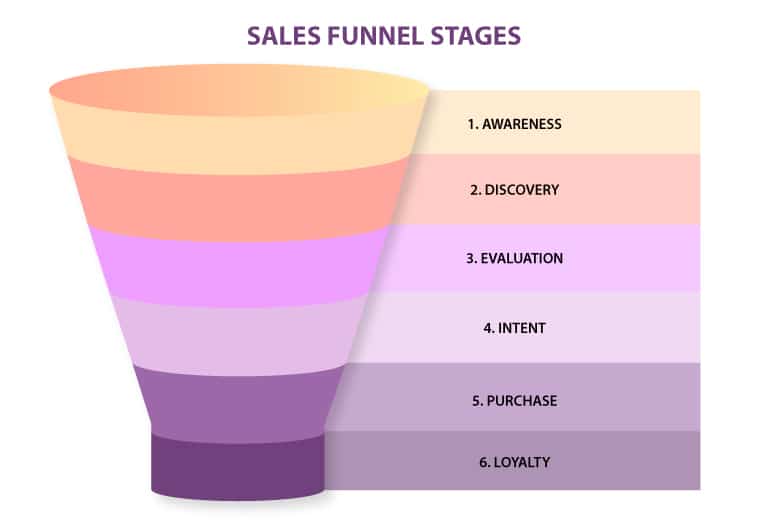
In more detail, the journey is usually split into six stages:
1. Awareness
The potential customer does not know your brand exists. They may not even know they have a problem yet. The goal here is to show up: a blog post that answers a question, a social video, a podcast mention or an ad. You are not selling yet, you are getting remembered.
2. Interest or discovery
The person wants to know more. They visit your website, follow your account or read several pieces of content. This is the classic moment for a lead magnet: a free resource (a guide, a template, a welcome discount) offered in exchange for contact details, usually an email address. Once someone shares it, they become a lead, a contact you can now talk to directly.
3. Consideration or evaluation
The lead compares. They check prices, reviews, alternatives and shipping or return terms. Honest comparisons, use cases, demos and clear answers to common objections work well here. If the lead fits what you sell, the sales team treats them as an “opportunity”.
4. Intent
There are clear signs they want to buy: they add a product to the basket, ask for a quote, start a free trial or keep coming back to the pricing page. This is where abandoned-basket reminders and retargeting (ads that follow you around other websites after you visit a shop) are used most.
5. Purchase
The customer pays. It looks like the end, but sales are lost here too: a form that is too long, shipping costs that appear only at the last step or too few payment methods can undo all the previous work.
6. Loyalty
After the purchase a new phase begins: making sure the customer is happy, buys again and recommends you. A useful follow-up email, good after-sales service or a rewards scheme cost far less than winning a new customer from scratch. That is why many modern models draw the funnel as a loop rather than a line that ends at checkout.
A practical example: an online gaming chair shop
Picture a small European online shop selling gaming chairs. Its funnel could work like this:
- Awareness: it publishes a blog post on “how to avoid back pain if you game for hours” and shares it on TikTok and Instagram.
- Interest: at the end of the post it offers a free guide to choosing a chair by height and weight, in exchange for an email.
- Consideration: over one week it sends three emails: a comparison of its models, reviews from real customers and an explanation of its 30-day returns policy.
- Intent: if someone adds a chair to the basket and does not pay, they get a reminder 24 hours later.
- Purchase: checkout takes two steps, with card, PayPal and local payment methods, and shipping costs are shown from the start.
- Loyalty: after 15 days it sends tips on adjusting the chair and, after three months, a discount on accessories.
Each of these steps can be measured separately, and that is what makes it possible to improve the funnel over time.
How to build a sales funnel step by step
If you run a business, a side project or are starting to sell online, these are the basic steps to build your first funnel without overcomplicating it:
Step 1: define your ideal customer
A buyer persona is a realistic description of your typical customer: their age, the problem they want to solve, where they look for information, what stops them from buying and how much they are willing to pay. Without it, the rest of the funnel is built blind. Ideally, base it on real data (surveys, customer conversations, web analytics) rather than assumptions.
Step 2: choose your entry channels
You do not need to be everywhere. Pick two or three channels where your customer actually spends time: SEO and blogging, social media, paid ads, partnerships or marketplaces.
Step 3: create a lead magnet worth having
The free resource has to solve a real problem and relate to what you sell. A template, a short email course, a calculator or a first-order discount work better than a generic PDF nobody will read.
Step 4: set up a nurturing sequence
Once you have the contact, you need to keep them company with useful content until they are ready to buy. Email is still the most common channel for this because it lets you automate sequences based on what each person does. If you have never built one, start with our guide to email marketing.
Step 5: make buying easy
A clear product page, the final price visible from the start, few checkout steps and several payment methods. Every extra form field is an excuse to leave.
Step 6: look after customers once they have paid
Instant confirmation, shipping updates, quick support if something goes wrong and a reason to come back. Loyalty is the most profitable stage of the funnel and also the most neglected.
Step 7: measure, test and adjust
A funnel is never finished. Check every month which stage loses the most people and test changes one at a time (a headline, an email subject line, the order of a form). Tools such as funnel exploration in Google Analytics 4 show you visually at which step users drop off.
Key metrics to measure your funnel
You do not need a dashboard with fifty indicators. These give you a fairly complete picture:
- Conversion rate per stage: the share of people who move from one stage to the next. It shows you exactly where the bottleneck is.
- Overall conversion rate: out of every 100 visitors, how many end up buying. It varies enormously by sector, price and channel, so compare yourself mainly with your own figures month by month.
- Customer acquisition cost (CAC): how much it costs you, including ads and sales effort, to win one new customer.
- Customer lifetime value (LTV): how much revenue a customer brings over their whole relationship with you. If LTV does not clearly exceed CAC, the funnel loses money even when it sells.
- Basket abandonment rate: how many people reach checkout and do not complete it. It often reveals problems with the final price, trust or payment methods.
Sales funnels and privacy: what the rules say in Europe
Much of a digital funnel runs on personal data: email addresses, tracking cookies, social media pixels and retargeting audiences. In the European Union that means complying with the General Data Protection Regulation (GDPR) and the ePrivacy rules on cookies, applied by each country’s data protection authority. The European Commission’s data protection page summarises the framework.
In practice, the minimum is:
- Real consent for non-essential cookies: the banner must let users refuse as easily as they accept, and advertising cookies cannot load before the user says yes.
- Permission to send marketing messages: downloading a lead magnet does not automatically allow you to send promotions. You must inform people clearly and, with some exceptions, ask for explicit consent.
- Easy unsubscribe: every marketing email must include a simple way to opt out.
A funnel that follows these rules does not just avoid fines: it also builds trust, and trust is what keeps people moving to the end.
The funnel from the other side: how to protect yourself as a shopper
Knowing how a funnel works also helps when you are the one buying. Many techniques are perfectly legitimate, but some are designed to make you decide quickly without thinking too much:
- Artificial urgency: countdown timers that reset, “today only” deals that come back next week or “only 2 left” warnings.
- Exaggerated social proof: “Laura from Berlin just bought this” pop-ups that are not always real.
- Persistent retargeting: the product you looked at follows you for days until you give in.
- Free trials with automatic renewal: you are asked for your card for a free month and, if you forget to cancel, the charges begin.
A few simple habits help a lot: wait 24 hours before buying something you had not planned, turn off advertising cookies and set a monthly budget for online shopping. Before paying, it is also worth checking that the shop is legitimate; our tips to identify a reliable e-commerce site help with that. A prepaid card can also give you a hand here: you only spend what you have loaded, so an impulse purchase cannot turn into an overdraft. With Bitsa, for example, you can create virtual cards for online shopping or subscriptions and top them up with the exact amount. If a free trial tries to charge you and the card has no balance, the payment simply does not go through. It does not replace your bank account and it is not a fix for everything, but it is a practical way to set a limit. You can read more in our article on the benefits of virtual cards.
Common mistakes when building a sales funnel
- Trying to sell at the first interaction: asking someone to buy as soon as they meet you usually scares them off.
- One message for everyone: you do not talk to someone who just discovered you the same way as to someone with the product already in the basket.
- Not measuring: without data you do not know whether the problem is the ad, the website or the checkout.
- Forgetting the customer after the sale: winning a new one costs considerably more than keeping the one you have.
- Too much pressure: fake urgency may work once, but it erodes trust and increases returns.
Frequently asked questions about sales funnels
What is the difference between a sales funnel and a marketing funnel?
The marketing funnel focuses on the early stages (attracting people and generating leads) and the sales funnel on the later ones (turning those leads into customers). In small businesses they are usually treated as one, because the same person handles the whole journey.
How many stages does a sales funnel have?
There is no official number. The simplest model has three (TOFU, MOFU and BOFU) and more detailed ones reach six or seven. What matters is that the stages reflect how your customers actually buy.
Do I need paid software to build a funnel?
Not to get started. With a website, an email marketing tool with a free plan and Google Analytics 4 you can build a basic funnel and measure it. Specialised platforms help once volume grows.
What is a good conversion rate?
It depends heavily on the sector, the price and the entry channel, so general figures are of little use. What helps is measuring your starting point and improving stage by stage.
Is retargeting legal in Europe?
Yes, as long as the user has consented to the advertising cookies or pixels that make it possible, as required by the GDPR and the ePrivacy rules. Without that consent, they cannot be used.