


What is a personal budget and how to make one in 5 steps
It is the 20th of the month and you are wondering where your salary went. You have not done anything crazy, but between rent, groceries, a couple of dinners out, subscriptions and the odd surprise, your account is emptier than you expected. It is a very common situation and it almost always has the same cause: there was no plan for the money before it was spent.
That plan is a budget. In this guide we explain what a personal budget is, what it is for, how to make one in 5 steps with a real example, which methods work best (such as the 50/30/20 rule), which tools you can use and the mistakes that make most budgets fail by the second month.
What is a personal budget?
A personal budget is a plan that estimates how much money you will earn and how much you will spend over a period of time, usually a month. Its aim is not to forbid you anything, but to decide in advance where each euro goes so your money ends up where it really matters: paying your bills, saving, protecting yourself against the unexpected and reaching your goals.
It is worth distinguishing it from tracking your spending. Tracking looks backwards: it records what you spent your money on. A budget looks forward: it decides how much you will spend on each thing before the month begins. Ideally you combine both: plan first, then check whether you stuck to the plan.
Why make a budget?
- Know where your money goes: many small, repeated expenses go unnoticed until you add them up.
- Reach the end of the month with room to spare: once you plan, your expenses stop catching you off guard.
- Save consistently: saving stops being “whatever is left” and becomes a fixed line in your plan.
- Build an emergency fund: a cushion for the unexpected that keeps you away from expensive loans.
- Reach specific goals: a trip, a house deposit, a new car or starting to invest.
- Reduce stress: knowing your month is under control is a real relief.
The basics: income and types of expenses
Before you start, it helps to be clear about four categories:
- Net income: what actually reaches your account after tax and social security contributions (not your gross salary).
- Fixed expenses: they repeat every month with the same or a very similar amount, such as rent or mortgage, insurance, your phone, internet or subscriptions.
- Variable expenses: they change from month to month and depend more on your choices, such as groceries, leisure, clothes, fuel or eating out.
- Occasional or annual expenses: not monthly, but certain to arrive, such as car insurance, property taxes, car inspections, holiday gifts, back-to-school costs or holidays. These are the ones that break most budgets, because people forget them.
The trick for occasional expenses is to spread them out: add up what they cost you in a year and divide by 12. If car insurance, gifts and holidays cost you €1,800 a year, set aside €150 every month. When the bill arrives, the money is already there.
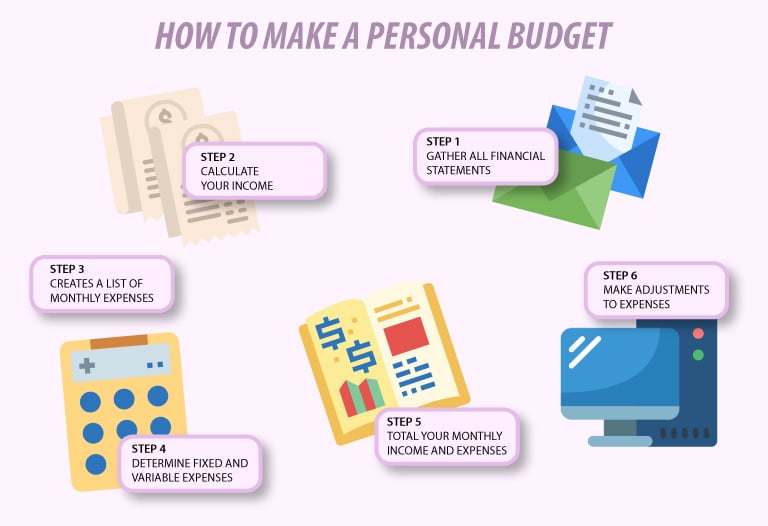
How to make a budget in 5 steps
Step 1: work out your monthly net income
Write down everything that comes into your account each month: salary, extra income, rent you receive or benefits. Always use net figures.
Two common situations in Europe need a small adjustment:
- If you receive a 13th or 14th month salary: in countries such as Spain, Italy, Portugal or Austria, extra payments in summer and at Christmas are common. They are not “extra” money to spend, but part of your annual pay. The safest approach is to budget with your normal monthly salary and use the extra payments for annual expenses, savings or your emergency fund.
- If you are self-employed or your income varies: calculate the average of the last 12 months and, better still, budget with a figure slightly below that average. Remember to set aside the tax and VAT you will owe in a separate account, because that money is not yours.
Step 2: review your spending over the last few months
Do not rely on memory: open your bank and card statements for the last three months and sort each expense into fixed, variable and occasional. Group them into simple categories (housing, utilities, food, transport, leisure, subscriptions, health, clothes, other). This step usually brings surprises: forgotten subscriptions, bank fees or small purchases that add up to a significant amount.
Step 3: subtract expenses from income
With the numbers in front of you, do the maths: net income minus total expenses (fixed, variable and the monthly share of occasional costs). One of two things will happen:
- You have money left over: great, now decide where it goes (savings, emergency fund, goals) instead of letting it slip away.
- You are short or only just breaking even: you are spending more than you earn or have no margin for the unexpected. That is your signal to tackle step 4 decisively.
Step 4: adjust and give every euro a job
Start with variable expenses, which are the easiest to change: set a monthly limit for each category. Then review your fixed costs, which often hide significant savings without giving anything up: comparing insurance, switching energy or phone tariffs, cancelling subscriptions you do not use or avoiding bank fees.
And apply one key rule: pay yourself first. Instead of saving whatever is left at the end of the month, set up an automatic transfer to your savings account on payday. What you do not see in your current account, you do not spend.
Step 5: review and adjust every month
A budget is not something you make once and forget. At the end of each month, compare what you planned with what you actually spent. If one category always goes over, the limit may not have been realistic; if another always has money left, you can move it to savings. The first three months are for fine-tuning: it is normal for things not to be perfect, what matters is keeping the habit.
A practical example of a monthly budget
Imagine Laura, who rents a flat in a European city and takes home €1,800 a month. After reviewing her statements, her budget looks like this:
| Item | Type | Monthly amount |
|---|---|---|
| Rent | Fixed | €750 |
| Electricity, water and gas | Fixed | €120 |
| Phone and internet | Fixed | €45 |
| Public transport | Fixed | €50 |
| Insurance | Fixed | €30 |
| Subscriptions | Fixed | €25 |
| Groceries | Variable | €300 |
| Leisure and eating out | Variable | €150 |
| Clothes and other | Variable | €80 |
| Annual costs spread monthly (gifts, trips) | Occasional | €50 |
| Total expenses | €1,600 | |
| Left for savings | €200 |
Laura saves 11% of her income. If she wants to reach 20%, she has room: reviewing her energy and phone tariffs could save around €30, cancelling a subscription she does not use frees up €10, and cutting leisure and clothes by €60 brings her close to €300 a month. It is not magic, just specific decisions that only become visible once the numbers are written down.
Methods for organising your budget
There is no single right method. These are the most popular; choose the one that suits you best:
The 50/30/20 rule
Split your net income into three blocks: 50% for needs (housing, utilities, food, transport), 30% for wants (leisure, treats, travel) and 20% for savings or paying off debt. It is easy to remember and works as a starting point. That said, in many European cities rent alone takes 30% or 40% of a salary, so do not worry if it does not fit: adapt it, for example to 60/20/20. What matters is that the savings block does not disappear.
Zero-based budget
You give every euro a job until income minus expenses and savings equals exactly zero. It does not mean spending everything, it means nothing is left undecided. It is the most precise method, but also the most time-consuming.
The envelope method
Traditionally, people put the cash for each category into an envelope and, once the envelope was empty, spending in that category stopped. Today you can do it digitally with separate accounts or cards for each category. It works very well for keeping variable spending under control.
Pay yourself first
The simplest of all: decide on a savings percentage, move it automatically on payday and spend the rest freely. It is ideal if you do not want to track every category but want to make sure you save.
Tools to build and follow your budget
- Spreadsheet: Excel or Google Sheets give you full control, and there are plenty of free templates.
- Your bank’s app: many automatically sort your spending into categories.
- Personal finance apps: they bring accounts together and alert you as you approach a limit. We review several in our selection of the best personal finance apps.
- Separate accounts and cards: one account for fixed costs, another for savings and a card for variable spending. Physically separating your money is one of the most effective ways not to overspend.
This is where a prepaid card can help you apply the envelope method digitally. With Bitsa, for example, you load the amount you have budgeted for variable spending each month (leisure, online shopping, treats) and you can only spend what is there: no overdrafts and no surprises. You can also create virtual cards to separate items such as online shopping or subscriptions, and the Free plan has no monthly fee. It does not replace your bank account, but it helps you set clear limits. You can read more in our article on the benefits of virtual cards.
The next step: emergency fund and savings
Once your budget is working, the money you free up needs a clear destination. The usual order is:
- Emergency fund: three to six months of fixed expenses in a separate, easy-access account.
- Clear expensive debt: revolving credit cards or payday loans.
- Medium-term goals: a house deposit, a car, further education.
- Long-term investing: so your money grows faster than inflation.
Common budgeting mistakes
- Being too strict: a budget with no room for enjoyment gets abandoned within weeks. Always include a leisure line.
- Forgetting annual expenses: car insurance or holiday gifts are not surprises, they are predictable costs to spread out.
- Budgeting with your gross salary: always work with what reaches your account.
- Leaving no margin for the unexpected: set aside a small amount for what you cannot predict.
- Not reviewing it: a budget that is never compared with reality is of little use.
- Giving up after one bad month: slipping at the start is normal. Adjust the figures and keep going.
If you cannot make ends meet
If, after adjusting everything you can, your expenses still exceed your income, do not cover the gap with payday loans or a credit card: that is the fastest way for the problem to grow. Prioritise essential costs (housing, utilities, food), talk to your creditors if you have debts to try to renegotiate payment terms and look for reliable information. Most EU countries run free financial education and debt advice services; the European Commission’s page on financial literacy explains the EU’s work in this area, and the ECB’s Financial Literacy in Europe map links to the official resources in each country.
Frequently asked questions about personal budgets
What percentage of my salary should I save?
A common benchmark is 20%, following the 50/30/20 rule. But what matters is to start, even with 5% or 10%, and increase it gradually. Consistency is worth more than the starting figure.
How often should I review my budget?
Ideally, do a quick check every week and a full review at the end of the month. It is also worth updating it whenever something important changes: a new job, a move or a new baby.
How do I budget if my income is irregular?
Work out your average income over the last 12 months and budget with a slightly lower figure. In good months, put the difference into a buffer that covers the leaner ones. If you are self-employed, also set aside what you will owe in tax.
Is an app or a spreadsheet better?
It depends on you. A spreadsheet gives you full control and makes you look at every expense, which helps you stay aware. Apps save time by sorting expenses automatically. The best tool is the one you will actually use every month.
What should I do with a 13th or 14th month salary?
The safest approach is not to count on it for monthly spending and to use it for predictable annual costs (insurance, taxes, gifts), to top up your emergency fund or to save. That way it does not vanish on treats within a few weeks.